


Vergil - Aeneid - Book One
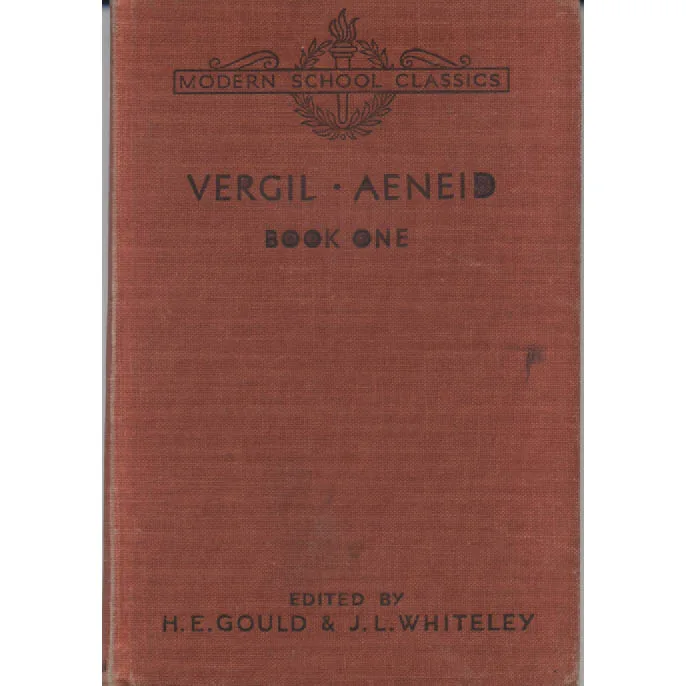
Publisher: MacMillan and Co
Format: Hardback
ISBN: none
Presenting: Vergil — Aeneid, Book One (1961, Macmillan & Co.) edited by H. E. Gould & J. L. Whiteley — a slim classical warship with a Latin sail and very English rigging. ISBN: none (because the ancients did not believe in barcodes). Condition: Good, which in the venerable dialect of second-hand booksellers means “well-kept, fully readable, and perfectly prepared to declaim arma virumque cano at your breakfast table without spilling the tea.”
This is the classic school-and-college edition that turned generations of students into people who can parse an ablative absolute before the kettle boils. Inside you’ll find the full drama of Book I: Juno’s weather-based policy initiative; Aeolus opening the atmospheric filing cabinet; Neptune turning up in his “keep off the dunes” hi-vis; Trojan ships limping into Libya; Venus doing divine customer support; Jupiter issuing a long-term strategic forecast for Rome; and Dido appearing with enough charisma to power three epics and at least one exam question. All of it in hexameters that stride like a legion and occasionally break into a light jog.
Gould & Whiteley provide the proper kit: line-by-line notes crisp enough to shave with, grammar nudges that rescue you from the subjunctive at the last minute, and vocabulary help that discreetly reminds you the difference between fert and feret when your brain insists on modernising. Expect scansion hints, cultural asides (who is this Ilioneus and why is he still talking?), and those tidy footnotes that translate “epic simile” into “exactly how many bees are we comparing to whom and why.”
From the outside: a tidy Macmillan academic paperback (or those sturdy mid-century boards, depending on print run) with honest shelf rub, a courteous spine crease, and pages in that tasteful ivory tone that whispers of lamp-lit prep rather than fluorescent interrogation. Our Good means sound binding, clean legible text, and the agreeable aura of a book that has been consulted rather than manhandled. The sort of volume that sits on your desk like a helpful don and never once sighs.
Inside, the texture is delightfully mid-century scholarly: economical type, sensible layout, and an editorial voice that assumes you are bright and merely need the odd nudge when Neptune starts remodelling the weather. You’ll get just enough archaeology and myth recap to bluff through a tutorial, plus the occasional elegant aside that explains why pius Aeneas is both a moral category and a plot device. The commentary moves quickly, but not so quickly you trip over your gerundives.
Why this copy? Because Crappy Old Books specialises in the noble paradox: decidedly un-crappy classics with enough lived-in charm to prove they were read by humans, not shrink-wrapped for eternity. Our Good is the sweet spot — opens flat for scansion, behaves itself for translation drills, and looks right at home between your Lewis & Short and a mug that says “sic transit caffeine.”
Ideal for:
-
Latinists who like their epic with practical footnotes and zero condescension.
-
Students facing unseen passages and seen-most-of-it nerves.
-
Readers who enjoy the moment when a thunderstorm becomes a character witness.
Side effects may include: involuntary hexameter in the shower, corrective muttering about “Vergil” vs “Virgil,” and an impulse to label your umbrella Arcitenens. You may also find yourself explaining to friends, unasked, why Neptune’s managerial style is the gold standard.
In short: a brisk, intelligent, unfussy guide to the gateway of Rome’s founding myth — Aeneid I with all the right nudges in all the right margins. Brought to you by Crappy Old Books, where the name is self-deprecation and the stock is paratus ad proelia (field battles optional, vocabulary inevitable).
This is an ex-school book from Old Palace school in Croydon.
If you order this one and get Book Two, please dont complain like the other miserable complaining customer that just had to have Book Two and not Book One. THey’re both gibberish, I don’t know what all the fuss is about.
Keep browsing: See more Ancient Classics books Other books by HE Gould and JL Whiteley
